Monday, January 30, 2012

As part of a class I'm currently taking from Yong Zhao on globalization and education, my colleague Jordan and I are conducting a series of interviews with local resident for analysis.  The goal of this interview process is to get a snapshot - an admittedly small sample size - of contemporary opinions regarding issues related to education and globalization.

Our plan is to ask each interviewer a battery of questions, which I have included below, and post their responses in a blog, along with reactions and further questions inspired by the interviewees' responses to the questions.  Finally, we will look at the collective of the responses and analyze them as a whole, taking a critical look at the commonalities of response and what they might say about our society's understanding of the issues confronted at the intersection of education and globalization.

Below are some questions I quickly jotted down during the first day of class that I envision as tools to query individual understanding of globalization and education, which are big terms that mean lots of things to lots of people.  I appreciate any feedback on questions that might be added, taken away, or tweaked.
  1. What does globalization mean to you?
  2. How do you think globalization impacts education?
  3. What is your perception of American education?
  4. Should teachers and/or parents concern themselves with globalization?
  5. Is globalization a good thing?
  6. Has globalization impacted you?  Your family?  Your community?  How and in what ways?
  7. What does globalization mean to you?
Obviously, anytime conclusions are to be drawn from data that consist largely of interviewee response, one has to consider how questions may cloud or color responses.  Just as I typed these up, I was struck by how the order of the questions could significantly impact a person's response.  That's something that I think can be addressed in the interviewer review and assessment of the interviewed subject.  Rather than trying to be overly scientific about definitions and categories, we are intending the questions to be a starting point for a discussion about the issues of globalization and education.  If questions are given in varying order and questions are added or subtracted, that's okay.  The real goods will be in the interviewee responses that are prompted by these questions.

Also, I intentionally repeated the first question, just as a kind of processing device to see how the prior discussion elicited new thoughts or reactions to the idea of globalization that were not evinced at the beginning of the interview.  I also hope that, rhetorically, the recognized repetition of the question will prompt the interviewee to take the opportunity to give a sort of final statement or conclusion concerning whatever they deem important about the topics discussed.

Tuesday, January 24, 2012

testing dead students

Cris Tovani, writing in So What do they Really Know? (Portland, ME: Stenhouse Publishers, 2011), makes a striking analogy between autopsies of the deceased and the typical multiple-choice, objective heavy standardized testing that is increasingly common in assessment-crazed, NCLB world of education.
Sure, an autopsy might inform the medical profession, comfort a family member, or provide useful information to a crime investigator, but it doesn't do anything for the person who has died. Like the autopsies, summative assessments can rank and categorize learners, give colleges a way to standardize how they admit prospective students, and allow parents to brag about their genius child. Unfortunately, they don't help students get smarter in the tested area (12).
This comparison struck me as both accurate in fact and powerful in imagery.  I definitely experienced this in my learning career.  As is common, Tennessee had a statewide writing assessment that everyone took in 7th grade.  The test was scored on a scale from 0-6, with the rubric having lots of bulleted descriptors of superior essays next to the 6 column, and 0 being described as either blank or "predominantly in another language."  I'll never forget that - "predominantly in another language" - it really sounded funny to me at the time, in the context of an essay test for 7th grade language arts.  It's illustrative of the type of stolid prose produced by a committee of exam drafters in league with state bureaucrats, like the common ethnicity choice on the same tests of "Black, not Hispanic."  This always implied all sorts of weird cultural assumptions to me.  It was as if blacks, unlike all other racial/ethnic groups, have some extra suspicion they must meet to prove they aren't Hhispanic.  Or maybe blacks wanted to make damn sure they weren't cross-categorized as also hispanics, so they received the extra opt-out.  I always wanted to write in "White, not black, potentially hispanic, and ancestrally European."

Anyhow, the chosen task was the persuasive essay, and I recall spending a decent amount of time in class going over how to write a good persuasive essay.  Now, that's not to say that the ability to write a persuasive essay is not a desirable skill to teach to 7th graders.  However, the execution of the assessment of that exercise was poorly thought out, just as Tovani describes:
With summative assessments, students are left out of the conversation. Rarely do they get to use the results to improve their performance. Summative assessments are too final. They tell the learner, "Time's up. Put your pencils down. If you don't know the information by now, it's too late." There isn't a lot teachers can do for the learners if summative data is available only after students have moved on to another grade level or class (12).
The state writing assessment I took was toward the end of 7th grade.  Naturally, these tests had to be sent off to...somewhere...so that grading was efficient and, above all, normalized.  An eternity of middle school summer later, I began 8th grade.  Just like the year before, I had a Language Arts class.  Not really remembering or even thinking of that past assessment, my 8th grade teacher one day decided to spend class talking about the writing assessment we did last year.  She had the grades, and she wanted to talk about how we all did, and what strategies we could use to write better persuasive essays.  She then told the class that, out of our city school systems two middle schools, I was the only student to get a score of 6 on the writing assessment.  The teacher presented this information as praise, and the class responded with Oooh's and Ahh's and few students said "wait to go, Parker" in various tones of smarmary.  I felt proud, I'll admit it.

The pride ended when the inevitable questions came: "What did you do so well Parker?"  "What did you write?"  My response: "Uhhhhhh...."

I didn't remember in the slightest.  I couldn't even be sure of what writing prompt I answered.  I had no idea what I had done, why I had done well, and what that meant.  All I knew was that I had done exceedingly well, congratulations.  Not even the teacher could refresh my memory, as she had no copy of the essay I had written or the graders scoring marks.  The only artifact was a number.

6.

Congratulations.  Now, try to do it again.  And we did.  Our 8th grade teacher apparently wanted us to all do essays for class, and she was going to grade them on the same 6 point scale.  A noble idea, certainly, as she very likely was reacting to the bad system of assessment that the state-wide writing test was.  This way, she would be able to give more meaningful feedback, and that feedback would be given to the students more quickly.  I got a 5.5 on the new essay, and I'm sure it wasn't perfect.  However, since the entire project had been introduced in response to the previous state writing test, and the same rubric was used, the comparison was implied.  Knowing my performance had decreased, I still had no knowledge of how or why, and, at the risk of belaboring the point, it all was because of the poor execution of the summative assessment.

More generally, it was because of the summative approach to assessment.  Just as Tovani stated, with lesson-final assessment, students often do not get the opportunity to compare their learning activities to the assessed product.  If they do, the chance to remedy the tested skill or improve the tested knowledge is not given.  With this approach to assessment, we deprive students of one of the fundamental goals of learning, which is improvement.  When tests are handed back and the only response is "Good Job" or "Did you not study?" we are not serving our students adequately.  Even the student who gets an A grade is not served, at least not any better than could be served without the teacher assessment.  This way, learning is transformed from an ongoing process of synthesis and improvement into a series of isolated moments of listening followed by disconnected moments of regurgitation.

Monday, November 14, 2011

"dirty hippies that just want to bitch"

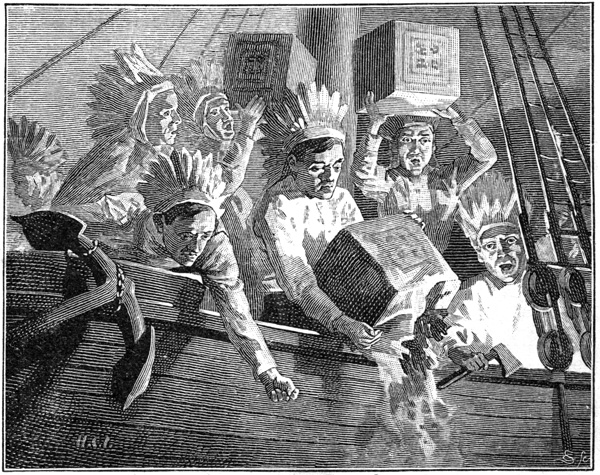
Today at work, the topic of the #occupy movement came up with a coworker.  The above statement was made in this context of me having previously defended the occupy movement's having resulted sometimes in destruction of property.  The thinking was expressed that civil disobedience is okay but when it turns to destruction of property, then things have gone too far.  So, I tried to make the counterpoint that, if you use that limit, you would have to reject some of the more famous acts of the American Revolution (War for Independence?), like the Boston Tea Party.

 destruction of property? i think yes

I thought this would be a pretty good tactic; no red-blooded, patriotic American can reject the country's uber-event, the American Revolution, in which the oppressed Americans through off their British overlords and established a new government...right?  Wrong.

"That was different," my coworker said.  "[The occupiers] are just a bunch of dirty hippies that want to bitch.  They are just complaining about banks."

 these guys look pretty clean cut to me...

That got me thinking.  Are the #OWS people really that different from the Boston Tea Partiers we honor as heroes in every American classroom?  My quick response to my coworker was that maybe today's protesters aren't all that different.  

"They weren't hippies, but that's because that word and culture didn't exist then.  But they probably were just as dirty, seeing as how bathing wasn't all that regular in the late 1700s."  But those points were a bit trivial.  Were the actual actions and desires of the Revolutionary protesters similar to those of the Wall Street occupiers?

"They are just complaining about banks."  Hmmm.  Well, assuming that's an accurate portrayal of the #OWS movement - which it's not - I think there are still similarities.  The "complaining about banks" is rooted in an unjust distribution and power over wealth, and I think that this could equally apply to the American Revolutionaries.  

Of course, the people of #OWS are upset about more than just banks.  They are fighting a legal system that enables those banks to benefit at the gross expense of others.  One of the big talking points has been about the unequal distribution of taxes.  Occupiers believe that the wealthy are unfairly advantaged by our country's tax code.  Now, if you remember anything from middle and high school American history, you know that the American Revolution had a lot to do with taxes.  The Stamp Act.  The Intolerable Acts.  The Sugar Act.  The Townshend Acts.  Those are the more common artifacts we teach our children when discussing the American Revolution, with the explicit understanding that those taxes were unfair and that the patriots were justified in rebelling against them.  "No taxation without representation" is taught as the slogan of the American Revolution.  Clearly, the issue of taxation is central to both movements.

Then, there's the allegation of unjust violence and destruction.  Obviously the American patriots were destructive.  Dumping the British East India company's tea into the harbor (I wonder if it was enough to make the ocean taste like English breakfast?), setting houses on fire.  But were they violent?  It's safe to assume, yes.  The practice of tarring and feathering, depicted in probably every American history textbook, was certainly violent enough.  Tax officers and other loyalists were physically restrained, denuded, rolled around in hot tar, and covered in feathers to be paraded around town for public ridicule.  Although we revere our patriotic ancestors, I'd say that a lot of Americans today wouldn't be all that comfortable with the practice of, say, ripping the clothes off of police officers or wall street executives and covering them in glue and feathers.  In fact, they would most certainly be arrested.

should #OWS employ this strategy?

Now, this isn't to say that we should be forming mobs, attacking the rich, stripping their clothes, tarring and feathering them, and burning their houses.  But I'm also not going to say that we shouldn't.  My point is that the opposition to the #OWS movement has arguments that are at least legitimate, even if I might not agree with them.  However, those same arguments applied to celebrated moments of our history would force us to reevaluate our opinions of those celebrated moments.  Does that mean that we should understand the American patriots as terrorists?  Should we acknowledge that the #OWS movement is doing something very similar to what the American patriots did?  

I think there are moments when breaking the law and getting aggressive become necessary and justified.  I've just tried to make the comparison to the American Revolution, in light of my conversation with my co-worker.  There are many other moments in history that would fit the bill.  Fighting slavery in the American South in the 1800s.  Resisting the Nazi aligned Vichy regime in France in the 1940s.  Is Occupy Wall Street of the same caliber?  If you don't think so, where would stand if you instead existed in those other moments in history?  How do you reconcile your belief in American independence and the abolition of slavery with your denial of the #OWS movement to fight the injustices that they see in their world?

track I'm currently listening to:

Friday, November 11, 2011

unity vs. gnome-shell

I really should start blogging again.  It's not a bad way to practice writing, something that I definitely practiced during the M.A. program but have neglected since about 2010.  While the UOTeach program has been really fun so far, it hasn't really required me to keep up my writing skills.   There are a lot of things I could talk about since...MAY of 2009???!?  Wow.  Well, let's start simple.

Ubuntu 11.10 - nicknamed Oneiric Ocelot - came out about a month ago.  Since it took me a while to get everything settled on my desktop when upgraded from 10.10 to 11.04, I decided to give the new-buntu a spin on my trusty eeepc. 

One major switch from 10.10 to 11.04 was the adoption of the Unity shell.  While innovative, I tend to think it's better suited to smaller form factor devices.  There has also been the quasi rival from GNOME, GNOME-shell.  As someone always itching for the new new thing (which got me into my "grrrr" mess when I upped from Maverick to Natty), I was curious about the two new interfaces.  Both were Ubuntu compatible, both were GNOME compatible.  It was a little confusing for the average user.  Unfortunately, you couldn't try GNOME-shell in Ubuntu 11.04 without breaking the Unity interface.  It was really something different and fun, which was something that Unity just wasn't to me - and still isn't.  But eventually, I had to give up fancy new shells and decided to stick with a classic GNOME 2 interface and Ubuntu 11.04, which I'm still using this moment.

However, my laptop really was hankering for some fresh spice.  Until recently, I was running a classic GNOME desktop and, while usable, it wasn't as satisfactory on my 10" netbook.  In comes Ubuntu 11.10, and, ta-da, GNOME 3 complete with GNOME-shell is easily installable from the repositories.  Immediately after upgrading the eeepc to Oneiric, I decided to switch from the default Unity interface to GNOME-shell.  I have to say, I was really impressed.  I prefer hitting the Super key to bring up all my windows (Exposé to mac people, though GNOME is calling it "Activities overview" which, while less trendy sounding, at least doesn't need translation like exposé) in GNOME-shell, as opposed to Windows key+something, which is default in Unity. 

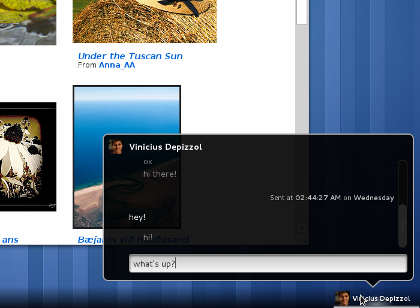
The way that notifications are handled in GNOME 3 is muuuuuch better than in Unity.  Let me show you what I'm talking about:
 in-line chatting in notifications with GNOME 3

In Unity, however, the notify-osd framework sticks around, with notifications that slickly dim when your mouse approaches, but they are not interactive, which is really where Unity fails, in my opinion.  I suppose a notification should be just that, new information on display.  But in GNOME 3 I can interact with those notifications.  I can see an instant message - from facebook, google talk, AIM or any other protocol - and I can choose to a) ignore it b) open the application itself and respond or c) respond right inside the notification.  That is just killer, especially on my netbook, which has the unwinning combination of a smaller screen and lower system specs.  If I can quickly respond to a chat without having to waste screen and memory to open the application, then I am a very happy linux user.
notify-osd notifications, straight from 9.04 Jaunty Jackalope, still in 11.10 with Unity

Why the Ubuntu team has been reluctant to add interactivity to notifications is beyond me, but team GNOME gets a big win on that front.  Ubuntu users have been quietly asking for this since 2009.

There are some other things to consider:
  • GNOME allows you to easily turn off all notifications.  That way when I'm in class, trying to take notes, I'm not getting inundated with Facebook statuses, tweets, and google talk notifications.  In Unity, as far as I can tell, the only way to do this is to log out of each of the services individually, and of course log back in at some later point.
  • Unity does get props for allowing me to easily post to twitter/facebook/google etc.  The post box in the me menu is pretty nice.  In GNOME-shell, I have to open up gwibber to do this.  Thus, it's the same exact problem I have with Unity's notifications, only in this case GNOME-shell loses
Both Unity and GNOME-shell Neither Unity nor GNOME-shell support easy customization of appearance settings (GTK, icons, etc.).  But it can be done with relatively little effort by adding the gnome-tweak-tool application

Soooo, that's all I have.  Like always, it's beset to try it out yourself and see what's good to you.  That's the greatness of Linux after all!


tracks while blogging:
  • "St. Ignatius" Rhett Miller w/ Ken Bethea, Live at Fez, New York, 4/4/2001
  • "Kindness" Ryan Adams, Ashes & Fire, 2011

Tuesday, May 19, 2009

american idol...i think not

So it's been over two months since the last post, and I blame that 100% on grad school. It has been quite a hectic year, and this last term has found me busy. No real life updates (hope to have a job update soon, however), but I did want to pass along a little note.

I went home after an interview for yet another mindless but money-paying job tonight, and since both Jeopardy and King of the Hill were over, my no-cable-paying self was left with either American Idol, Dancing with the Stars, or NOVA on PBS for entertainment while my delicious Totino's pizza to cook. Needless to say, I took the intellectual high ground...

The episode, Parallel Worlds, Parallel Lives, was about one Mark Everett, leader of an indie-rock band, and his quest to learn more about his dead, estranged father. The neat part is that his father just happens to be a world-famous (or infamous) physicist who first developed the many worlds interpretation of quantum mechanics. If that sounds like a lot to swallow, just start clicking around wikipedia and your feeble brain will get inundated with confusing thought experiments concerning quantum suicide and theories about infinite alternate universes.

But the documentary was very nicely done. They do a great job weaving together the story of Mark finding his father with a fun and simple yet informative explanation of Hugh Everett's theories, creating...wait for it...parallel stories! Oh, that felt nice. Points for me.

Last, but certainly not least, Mark "E" Everett is a musician...

I don't need to say more, I know, but they played some of his music as cuts during the film, and it didn't sound too shabby. I know I will checking him out (band is The Eels), and you should too. The film is nice too. It won a BAFTA award, so you know it's got something to offer.

Anyways, hope all is well. Spring in Eugene is almost too pretty to bear (I still have to think about which form to use with that word). I saw a raccoon outside McKenzie on my way over.

Thursday, February 12, 2009

why i enjoy the university atmosphere

In most places, when you walk into the men's room, if you find some reading material it's usually yesterday's sports page or, if you're lucky, a magazine. But if you were to walk into the stall up here on 3rd floor McKenzie at the UO, you'd find last quarter's issue of the American Political Science Review. Instead of reading about A-Rod and steroid drama, I got to learn about the first study to demonstrate a link between genetics and various forms of political participation.

Thank you, Plato

Saturday, February 7, 2009

keepin up

Well hello. The Chumblog has seen better days, I know, so this post will try to remedy that.

Much has changed since we last left off. In case you haven't heard...
  • America has a black President (though whether he is actually that amazing is still up for debate
  • I (successfully?) completed the first term of grad school
  • the new topical blog has gotten off to a verrrry slow start
  • I have struggled to kickstart a new era of ma vie (in more ways than one)
  • the ducks beat the oklahoma state cowboys in the 2008 Holiday Bowl!
All of these things have combined to create quite a new world for a chumber. Fortunately, each new experience brings excitement. My life has been consumed by equal parts of
  • reading; (okay not really, but I gotta pretend)
  • class
  • rererediscovering that great phenomenon we call "music" via last.fm, as well as other things which shan't be spoken of on the interwebz...
  • getting closer to the ideal computing setup via, among other things, rhythmbox to listen to my music and share it with others, dropbox to sync files between my desktop, laptop, and cloudtop, simplifymedia to share my music and listen to that of even more people, and ubuntu to string it all together
  • trying to forego eating out for buying groceries and, shocker i know, making meals
  • playing pool and, occassionaly, playing pool well
  • and becoming friends-bordering-lovers with my roommate (although no one should fret...old roommates have special real estate saved in my heart).
There have been countless news articles and happenings that I've wanted to comment on here, but I never really got around to it. I'll make up for it with two today.

In a great opinion piece for the NYT, the top dog over at Netflix gave his opinion on how President Obama should handle the issue of exorbitant pay to big time CEO's. I'll let you read the article on your own (it's short), but this pretty much sums it up:
Perhaps a starting place for “tax, not shame” would be creating a top federal marginal tax rate of 50 percent on all income above $1 million per year. Some will tell you that would reduce the incentive to earn but I don’t see that as likely. Besides, half of a giant compensation package is still pretty huge, and most of our motivation is the sheer challenge of the job anyway.
If only we had more guys like Reed Hastings...

Completely unrelated but even more interesting to me is the saga of a legal proceeding involving a grad student at Boston University and that evil, silly, asinine, backward consortium of crooks called the RIAA. After doing something that most like every college student has done at one point, Joel Tenenbaum was served by the RIAA and very quickly was facing the difficult choice of settling for $10,000 or going to court against a huge corporate legal machine. That is, until a Harvard Law professor, Charles Nesson, who runs a class on hands-on legal experience and specializes in internet and society, decided to take on the case as one the course's projects. The project has brought on several young law students and has generating quite a following. One early victory was when the students working on the case successfully convinced the judge to allow a pretrial hearing to be streamed over the web (against heavy RIAA complaints of course). For more on the case, see this article over at Ars Technica.

I've always been excited about file sharing and the new (I hope) music discovering paradigm that can be created with things like computers that are linked together over things like the internetz. While plenty of people find this to be highly bad and illegal and maybe even wrong, even calling it 'piracy,' I'm keeping an open mind about it all. The article linked below makes mention of how Radiohead made more money than their all their previous cd sales combined using one simple, seemingly dumb tactic: allow people to choose their own price and download the CD for whatever they wanted. The experiment worked great, and other artists have picked up on it. I just bought my first from Roman Candle...gave $3.50 for their latest. I think it's great. They even had a choice of bitrate and file type. The future is on it's way....For a really long but absolutely exquisite and perfectly informative discussion on the whole debate, read this piece written in the aftermath of the shutdown of OiNK's Pink Palace, a filesharing community that I was a member of and miss everyday.

Okay, well, that's looking like a pretty good post. Hopefully it won't be several months before I find the time to rant again.

And, one more thing. Listen to the everybodyfields. It will sooth your soul.