Showing posts with label Ubuntu. Show all posts

Sunday, March 25, 2012

Ubuntu's new HUD concept


Today I upgrade netbook (Asus EeePC 1005HA) to the pre-release of Ubuntu 12.04, coming from months of using 11.10 happily, primarily gnome-shell, which I find better suited to my laptop needs - it's less invasive visually in terms of notifications, less cluttered in the top panel, and that's about all I care about when I use it for little more than taking notes in class and accessing the internet on the go.  It sounds simple, but I like having the date and time top and centered as it is in gnome-shell.

However, I have been intrigued by this new HUD concept that debuts in Ubuntu precise pangolin.  While I have passed the period of my life where I update every time something new comes along (I still am running 11.04 on my desktop and still sometimes wish I had stuck with 10.10) only to see something break or a feature change that I don't personally like, I nevertheless get itchy about major version upgrades, and what could be more major than the first LTS edition of your operating system in two years?


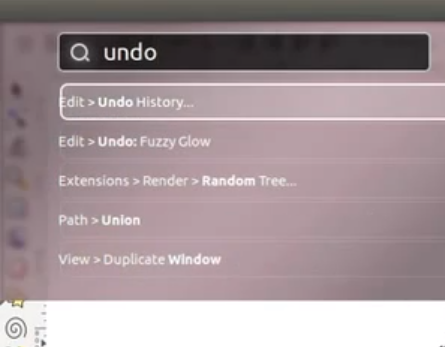
In some cases, I think that the transition from menu tree based navigation to a universal search model à la the HUD has some kinks to work out.  The first thing that comes to mind is context.  If you watch the video linked above, when the command to undo the glow in Inkscape, you see that the Ubuntu devs are touting easy discoverability of commands via the HUD, obviously in an attempt to woo any curmudgeons complaining about losing their precious menus.  However, their choice to simply present commands as the tail item of a list of what used to be menu choices leaves much to be desired.  Rather than go full on command-centric, Ubuntu is really just presenting menu trees in a new format.

Now, some will say that this improves context of commands, so that users can better intuit what the command should do, if it is an unfamiliar one.  However, typing "undo" results in options for "undo glow" or "undo history."  For the unfamiliar user, the differences between these commands might be hard to determine.  In a menu tree, options and commands are presented in an intentional format, and even if we might quibble about whether "Preferences" should be under tools or edit, the placement doesn't change once we have learned it.

That brings me to my next point - learning curves.  My immediate reaction to the Unity HUD was that it was a pointless change to a perfectly usable method of computing that everyone already understood.  I thought of my experience switching from Microsoft Office 2003 (still the best suite, imo) to the completely redesigned ribbon interface of Office 2007.

I HATED IT.

After a good two years spent memorizing all of the keyboard shortcuts for the commands most relevant to me, everything was moved around the menus.  Alt+I+N+N didn't give me a footnote anymore, and I wanted to cry.


Then I realized...a shift from menu tree based navigation of commands to a HUD-style approach would help avoid such problems.  Rather than keyboard commands tied to a menu tree placement that changes at the whims of developers, a universal access point for commands would mean that [SuperKey] plus "foo" would give me access to insert a footnote every time.

Stop and think about that.

Application developers could update their programs without the fear of changing things too much, thereby allowing their time and resources to be devoted to the actual processes and content that the application is designed to deal with and not the presentation of commands and feature modalities.  No more would you need to go a googling to figure out how to make Office 2007 look like your friendly pal Office 2003 by installing plugins from Switzerland.  Users would not be faced with the unenviable choice between upgrading and losing their preferred interface or holding pat and losing out on advanced features and new compatibilities.

In spite of all the rabid anti-change bloggings of tech-conservative computer geeks, not everyone already understands the basic menu tree paradigm.  Young computer newcomers are growing up tapping iPhones and not messing about going to File...New...Tab... in order to pull open a new webpage.  And the reference to iOS is no mistake.  Indeed, we can see that Apple made one-stop access via the keyboard a priority way back in 2004.

want to listen to Sandra...email her...stalk her on facebook?  Apple spotlight has you covered
And, as so many fanboys are wont to complain, everyone else has followed suit.

RIM's blackberry 7 included universal search as one of the main new features
Android of course had to get in on the fun
popular tool GNOME-Do, itself inspire by quicksilver for mac, brought fast Do-ing via the keyboard to the masses


and of course, iPhone is all about its spotlight
Unity HUD...biting some style, no harm done

Obviously, modern computing - at least for the content driven, app-tapping masses - is moving toward this paradigm.  With several major players representing a huge swath of human-computer interactions converging on universal search, it only made sense for Ubuntu to do the same, and they have made an interesting first step with the HUD.

And they have not completely made an Ubuntu-purple version of Spotlight.  In fact, if you look at each implementation I referenced above, there is one key commonality that the HUD does not share.

Spotlight, Blackberry's and Android's universal search, and the iPhone all focus on indexing and presenting content.  The Unity HUD, rather, applies the universal search model to command access.  While GNOME-Do also served as an application launcher and could perform basic application functions such as pause music in Rhythmbox and search Firefox bookmarks, all of GNOME-Do's functionality was plug-in dependent, and in no case could Do serve as a replacement for the menu-tree of commands.

The Unity HUD, however, is seeking to be at least a fully capably alternative, if not a replacement for traditional point-click menu computing.  I am curious to see how it goes, but I definitely see it as a step in the right direction.

Friday, November 11, 2011

unity vs. gnome-shell

I really should start blogging again.  It's not a bad way to practice writing, something that I definitely practiced during the M.A. program but have neglected since about 2010.  While the UOTeach program has been really fun so far, it hasn't really required me to keep up my writing skills.   There are a lot of things I could talk about since...MAY of 2009???!?  Wow.  Well, let's start simple.

Ubuntu 11.10 - nicknamed Oneiric Ocelot - came out about a month ago.  Since it took me a while to get everything settled on my desktop when upgraded from 10.10 to 11.04, I decided to give the new-buntu a spin on my trusty eeepc. 

One major switch from 10.10 to 11.04 was the adoption of the Unity shell.  While innovative, I tend to think it's better suited to smaller form factor devices.  There has also been the quasi rival from GNOME, GNOME-shell.  As someone always itching for the new new thing (which got me into my "grrrr" mess when I upped from Maverick to Natty), I was curious about the two new interfaces.  Both were Ubuntu compatible, both were GNOME compatible.  It was a little confusing for the average user.  Unfortunately, you couldn't try GNOME-shell in Ubuntu 11.04 without breaking the Unity interface.  It was really something different and fun, which was something that Unity just wasn't to me - and still isn't.  But eventually, I had to give up fancy new shells and decided to stick with a classic GNOME 2 interface and Ubuntu 11.04, which I'm still using this moment.

However, my laptop really was hankering for some fresh spice.  Until recently, I was running a classic GNOME desktop and, while usable, it wasn't as satisfactory on my 10" netbook.  In comes Ubuntu 11.10, and, ta-da, GNOME 3 complete with GNOME-shell is easily installable from the repositories.  Immediately after upgrading the eeepc to Oneiric, I decided to switch from the default Unity interface to GNOME-shell.  I have to say, I was really impressed.  I prefer hitting the Super key to bring up all my windows (Exposé to mac people, though GNOME is calling it "Activities overview" which, while less trendy sounding, at least doesn't need translation like exposé) in GNOME-shell, as opposed to Windows key+something, which is default in Unity. 

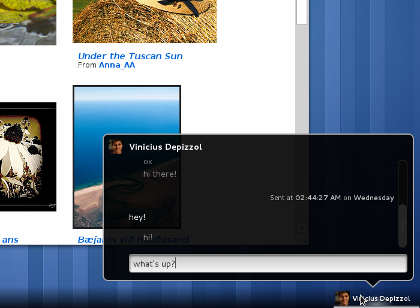
The way that notifications are handled in GNOME 3 is muuuuuch better than in Unity.  Let me show you what I'm talking about:
 in-line chatting in notifications with GNOME 3

In Unity, however, the notify-osd framework sticks around, with notifications that slickly dim when your mouse approaches, but they are not interactive, which is really where Unity fails, in my opinion.  I suppose a notification should be just that, new information on display.  But in GNOME 3 I can interact with those notifications.  I can see an instant message - from facebook, google talk, AIM or any other protocol - and I can choose to a) ignore it b) open the application itself and respond or c) respond right inside the notification.  That is just killer, especially on my netbook, which has the unwinning combination of a smaller screen and lower system specs.  If I can quickly respond to a chat without having to waste screen and memory to open the application, then I am a very happy linux user.
notify-osd notifications, straight from 9.04 Jaunty Jackalope, still in 11.10 with Unity

Why the Ubuntu team has been reluctant to add interactivity to notifications is beyond me, but team GNOME gets a big win on that front.  Ubuntu users have been quietly asking for this since 2009.

There are some other things to consider:
  • GNOME allows you to easily turn off all notifications.  That way when I'm in class, trying to take notes, I'm not getting inundated with Facebook statuses, tweets, and google talk notifications.  In Unity, as far as I can tell, the only way to do this is to log out of each of the services individually, and of course log back in at some later point.
  • Unity does get props for allowing me to easily post to twitter/facebook/google etc.  The post box in the me menu is pretty nice.  In GNOME-shell, I have to open up gwibber to do this.  Thus, it's the same exact problem I have with Unity's notifications, only in this case GNOME-shell loses
Both Unity and GNOME-shell Neither Unity nor GNOME-shell support easy customization of appearance settings (GTK, icons, etc.).  But it can be done with relatively little effort by adding the gnome-tweak-tool application

Soooo, that's all I have.  Like always, it's beset to try it out yourself and see what's good to you.  That's the greatness of Linux after all!


tracks while blogging:
  • "St. Ignatius" Rhett Miller w/ Ken Bethea, Live at Fez, New York, 4/4/2001
  • "Kindness" Ryan Adams, Ashes & Fire, 2011

Thursday, April 17, 2008

i'm alive

So I know I've been neglecting the Chumblog for a bit now, but things have been quite hectic. Let's see, since my last post of the 29th of February, what all has happened in life? Hmmmm
  • well, I've received the rest of my rejection letters, as well as some accepts with no funding from Colorado and Tennessee, and one final notification that it isn't happening at Brandeis
  • I visited the University of Oregon up in Eugene for spring break
  • My laptop has been fried, which in turn ...
  • caused me to discontinue the online portion of my senior seminar project
  • I recently accepted the offer at Oregon
  • And today, my new lcd monitor came in the mail.
So that's a lot of exciting stuff. Add that to the stress and excitement of graduating from college. I really don't know what to think about it all. I'm super stoked about heading to the Northwest for a new adventure, but leaving Centenary will definitely be sad.

After my last major other obligation, my time has been increasingly dedicated to senior sem. Even though I neglected it for a time because I was annoyed with my computer and I just didn't care too much since I was already into school for next year, now I'm a wee concerned that I'm going to be embarrassed about the final project. So we are going to try and make sure that doesn't happen. In related new, the more I work on it the more I think I'd like to be an American historian. Shhh, don't tell that to the good folks at Oregon. I also was really keen on American for a time in the past, but then I really got into European when I was working more in that here at school, so hopefully that will happen again ;)

I mentioned a monitor came in for me. Yes, I don't have a working computer so it may seem weird, but I got it for a good deal on Newegg and the computer I'm pretty sure I'm going to buy this summer doesn't come with a display so I'll need one.

I really didn't have much to say on this blog, but blogger's photo uploader is quite sloow. I added some integrated links to the text to pass the time and help you reader's enjoy my loving contribution to web 2.0.

OKAY, well it looks like it's the slowness of my school's internet connex. Thank you kindly, Apogee.

EDIT: Everything except for google pages and blogspot is running smooth, so maybe this problem is on google's end. I guess that's what you get when one company runs the entire internetz. To Apogee, you don't deserve any apologies because you suck on a regular basis.

So I'll just sign off for now. The image was a screenshot of me running Ubuntu that demonstrated the compiz cube effect and transparent windows, as well as IEs4linux

EDIT: I uploaded it to facebook, but it's smaller res so you'll just have to deal...

Why run IE on any computer, much less a linuxbox, you ask. Well, I read that it helped to get IE up before you tried to fool with using Microsoft Word in Wine. Why not OpenOffice.org Writer you say? Well, frankly, I hate Oo.o so far, and am desperately trying to configure Word 2003 here. That's why.

Friday, February 29, 2008

close-minded professors and open source software

My life has recently been consumed by all things graduate school...last fall it was applying and convincing four professors that 18 schools was not too many and that writing letters for a number of them on my behalf wouldn't be all that time consuming. The first part of Winter, from January 15 to February 1, was a brief respite from all the hubbub. However, the days since then have been even more dreadful than the entire process of filling out applications, printing statements and writing samples, and coordinating it all with professors.

This, my friends, is the season of decision notification. After gleefully reading an acceptance letter from the University of Wisconsin, I have systematically been humbled by some of the finer institutions of America. Part of me thinks there is a History Department Roundtable that convenes and decides to trick students into thinking they are worthy, only to follow up with a plethora of "sorry, but we just had so many applicants this year..." letters. Fortunately, two discoveries have given me a modicum of enjoyment during this apprehensive time: one close-minded professor and an unrelated bit of free software.

My wonderful political science professor, Rodney G
runes, makes our class read the New York Times everyday. I've been following the primary season using precisely that outlet, and in Tuesday's Op-Ed section I found an interesting piece. Apparently they had the neat idea of asking several different experts what questions they thought were being ignored in all the debate. Most of the respondents seemed thoughtful enough, but then I got to the questions of one Ruth Wedgwood, professor of international law and diplomacy at Johns Hopkins University. JHU is one of those schools that, unfortunately, will not be graced with my presence this coming fall, and reading the ridiculously hawkish, narrow-minded, stupid comments of Prof. Wedgwood took most of my rejection pain away. Her first, and, reason leads us to believe, most natural, question, was,
Senator Obama, as commander in chief an American president must understand the sense of honor that motivates his armed forces. Last September, MoveOn.org ran an advertisement in The Times that mocked Gen. David H. Petraeus, the American commander in Iraq, as "General Betray Us." You chose not to vote on the Senate resolution that condemned the advertisement. Would you still characterize the Senate vote as a "stunt" and "empty politics"?
The fact that this was apparently the most pressing issue on the mind of this well-paid professor at one of the more illustrious institutions of higher learning in our nation is disturbing. With the dire economic situation, millions of Americans without health care and facing home foreclosure, the entire international scientific community talking about environmental tiping points and a climate that is literally on the brink of destruction, Professor Wedgwood is primarily concerned that Senator Obama didn't step up to the plate and censure an organ of the American free press. Apparently honor means never allowing the people to utter a negative syllable about an individual with bars on his shoulder.

Wedgwood also takes a parting shot at Senator Clinton when she says
The 22nd Amendment to the Constitution bars any former president from election to a third term. Is it truly consistent with the spirit of the Constitution to have the same professional couple occupying the White House for 12 years? Isn't this all the more true when Bill Clinton promised that voters would receive, during his first term, "two for the price of one"?
Only finding such absurd and embarrasing comments has made me realize that I could never be happy at an institution that rewards such an obvious lack of scholarship, intelligence, and courtesy. I'm going to go out on a limb, temporarilly ignore my rule gainst generalizing, and possibly even display a tiny bit of animosity, and say that I doubt such statements would ever come from the lips, pen, or keyboard of any professor from any department at the more progressive, prestigious, and higher-ranked-by-US News & World Report University of Wisconsin-Madison, a beacon of learning that provides cultural, intellectual, and practical support to an entire state of cold, loving, Packers-cheering people.

The latter half of the title to this entry refers to my newfound interest in open source software, specifically the Ubuntu distribution of Linux. Some kind soul left an installation CD in the library, and I've since tested it out and fallen in love. It should be noted that I'm writing this blog after booting from the CD. I've decided that the first thing I buy with my next paycheck is going to be an external harddrive, partly so that I can backup my music and other files, partly so that I can install Ubuntu (or possibly Xubuntu) on my laptop. It's very exciting.

To close, I'll give you what Newsweek's Conventional Wisdom would look like if I was writing it this week: Microsoft goes down for not keeping up with the times, the NYT editorial board goes up for providing me with a laugh, Google goes up for making viable server-side solutions to propriety software, dedicated nerds all over the world go way up for slowly paving the way to a post-Microsoft world, the JHU board of trustees drops for hiring Beth Wedgwood, and every citizen of Wisconsin climbs to the top for never allowing such a tragedy to happen.